
Losing Sucks
But there's no better way to learn chess

Welcome back to Chess in Small Doses, a Substack about adult improvement in chess. Today, I’m discussing winning and losing. To play chess means to risk losing. Two games from last week demonstrate the indispensable role of risk and loss in learning chess. In one of those I was clearly the more experienced, better player. In the other, I was clearly the lesser player. Losing just plain sucks. However my experience has been that there’s no better way to learn this game. Let get into it.

Winning
Game 1 was part of the ChessDojo Open Classical Tournament I signed up for recently. I like this format since it’s 90+30 games and most opponents will take the game seriously. I used to pay for the Dojo but now just sort of lurk about, waiting for the tournaments to jump in. In this game, I had time to prep for my opponent. It seemed he preferred the play the Stonewall Attack, a recommendation of NM Robert Ramirez. From the Black side my opponent also played the Pirc, the recommended opening for Black also from Ramirez. I was going to play Black and usually play the Slav, but had never faced the Stonewall before. What I was aiming for was this line: 1.d4 d5 2.e3 Nf6 3.Bd3 Nc6!? 4.f4 Nb4
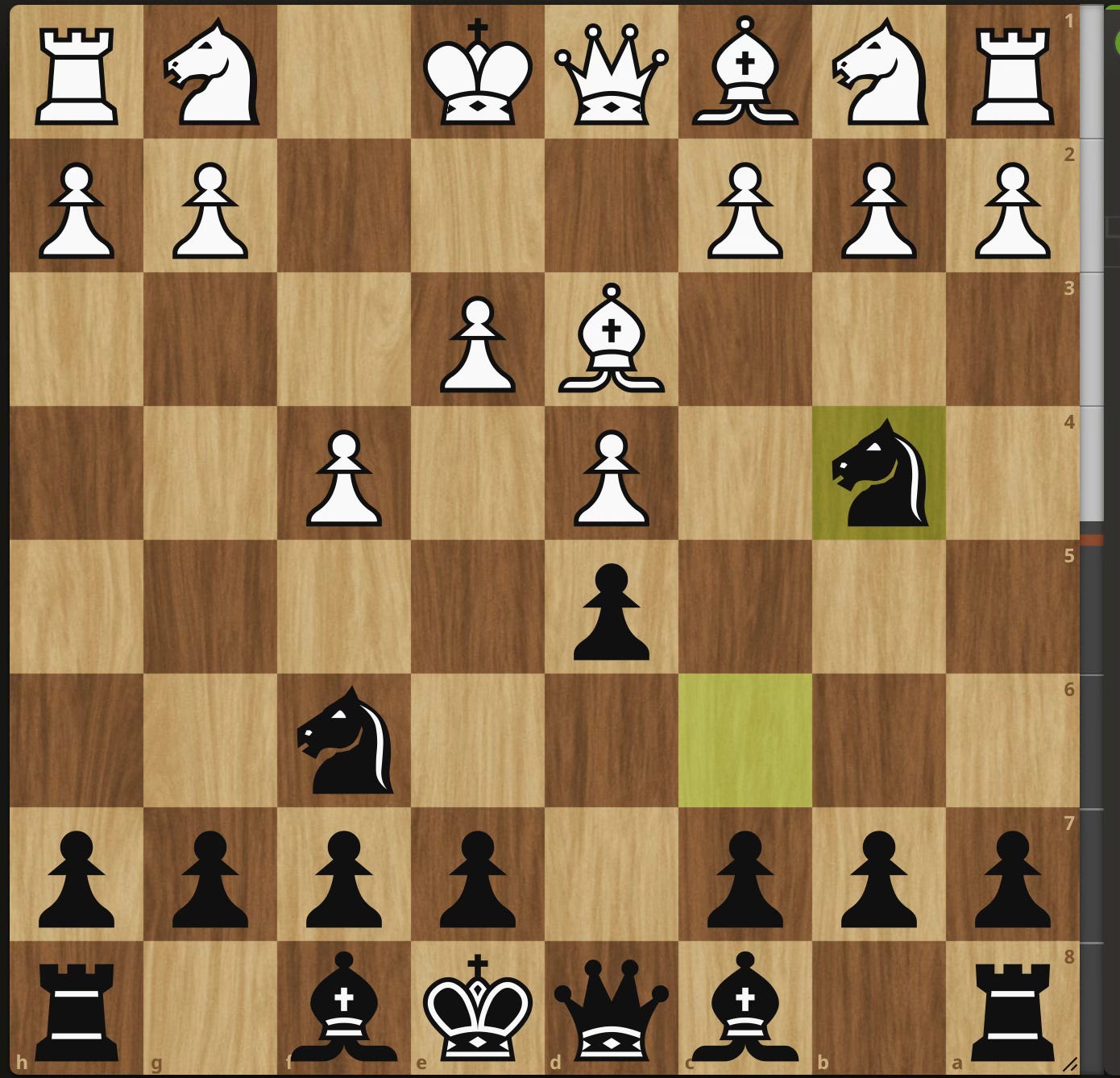
Here Black can either take the bishop if White doesn’t move it, or in the case of Be2 then Bf5 to take away the diagonal and threatened Nxf7+. Na3 is the only defense which gives Black a chance to play c5 and equalize. While I didn’t get this exact line, my prep proved useful anyway and helped me win this blitz game later.
Credit to my opponent he changed up his opening move order. I was out of prep but felt I knew what to do. I missed one move in the opening and got a slight worse position which you can see here:
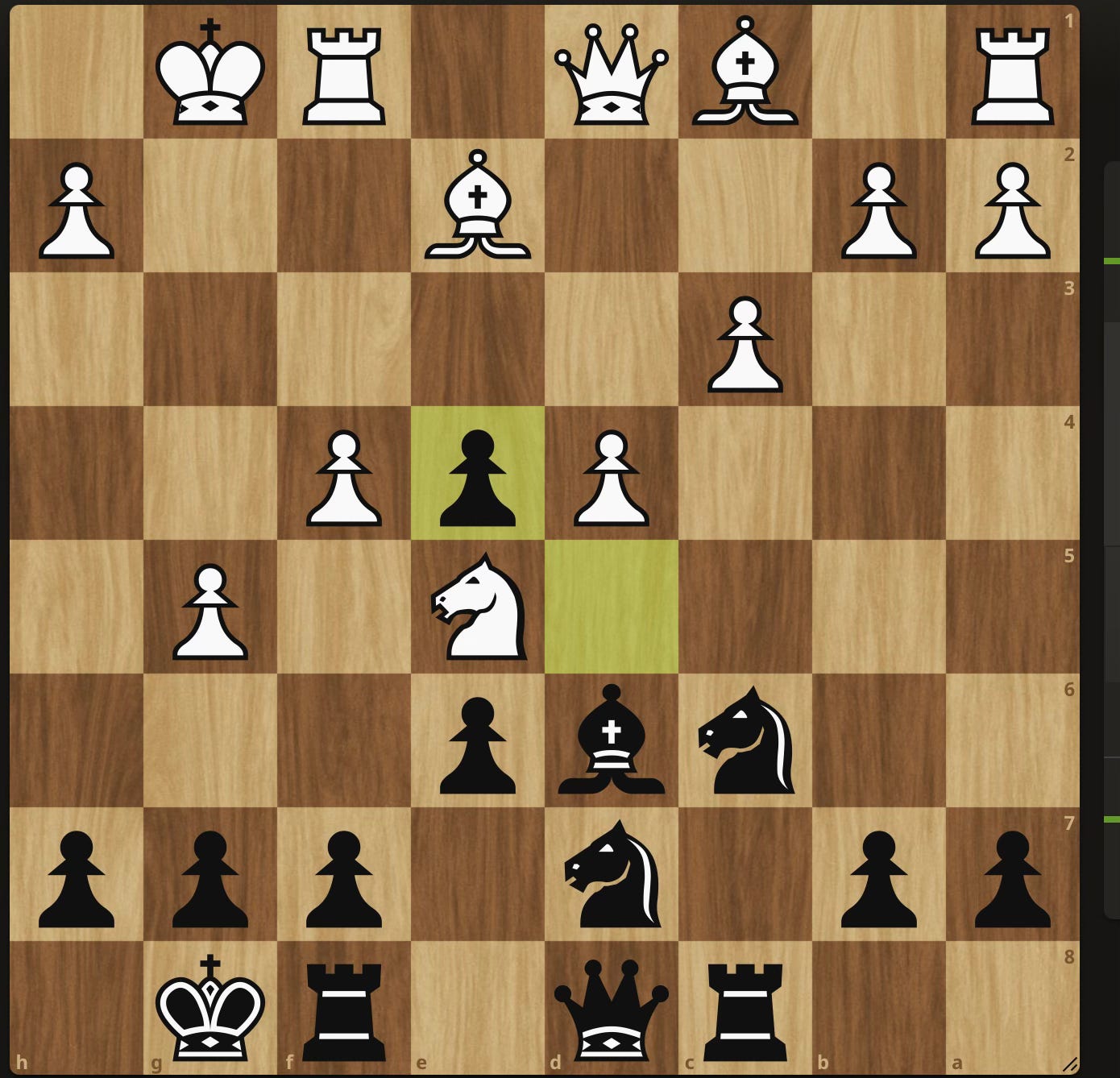
I’ve lost my LSB and White has a knight on e5 with advanced pawns. Black has to be very careful. However, my opponent blundered next, playing Qc2?? He was clearly aiming for the e4 pawn, but missed the discovered attack along the c file with Nxd4!.
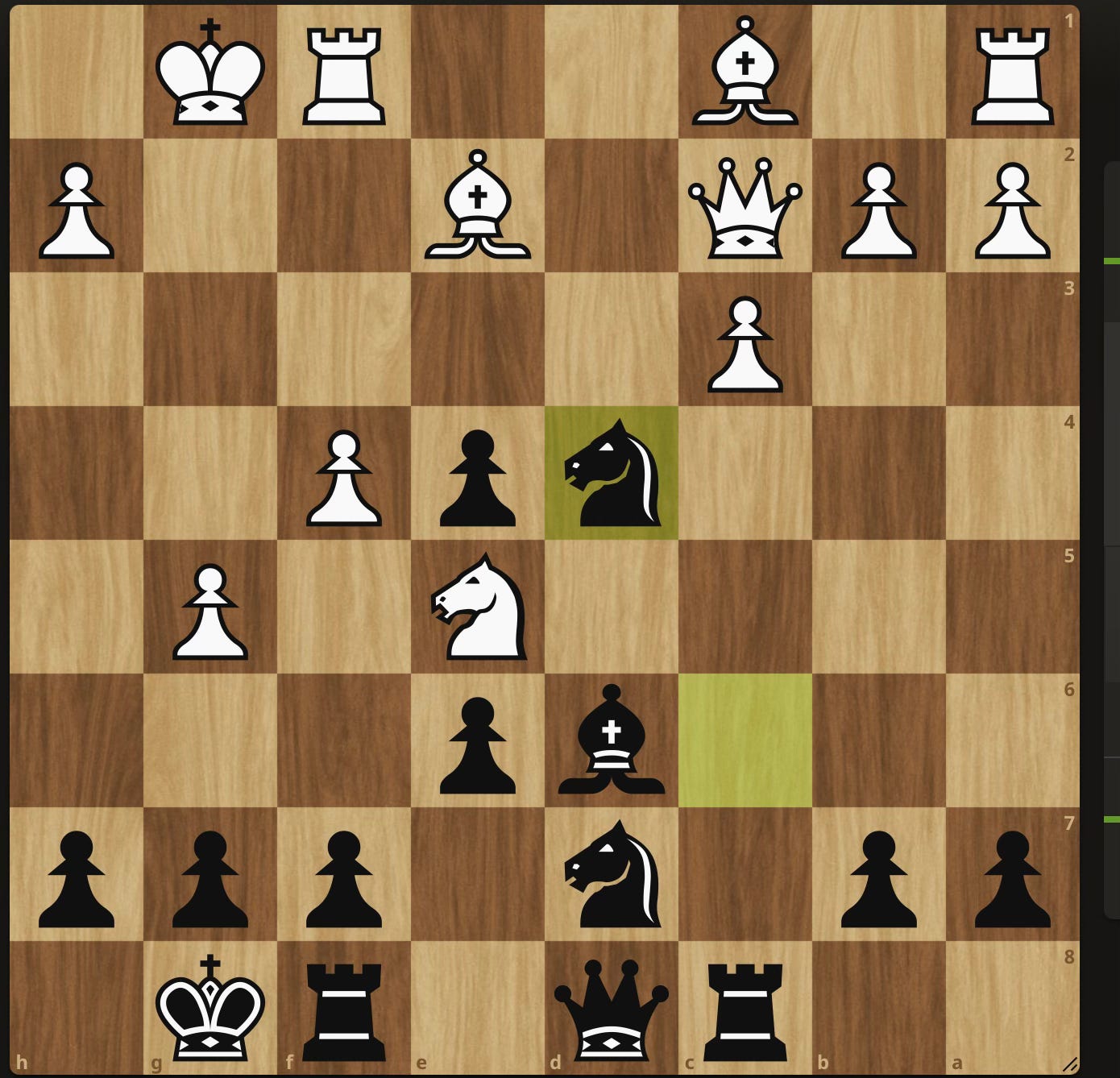
After Qxe4 Nxe2 Qxe2 Nxe5 fxe Bc5+ Black is winning. Credit to my opponent but he played on, fighting all the way until the end when mate was unavoidable.
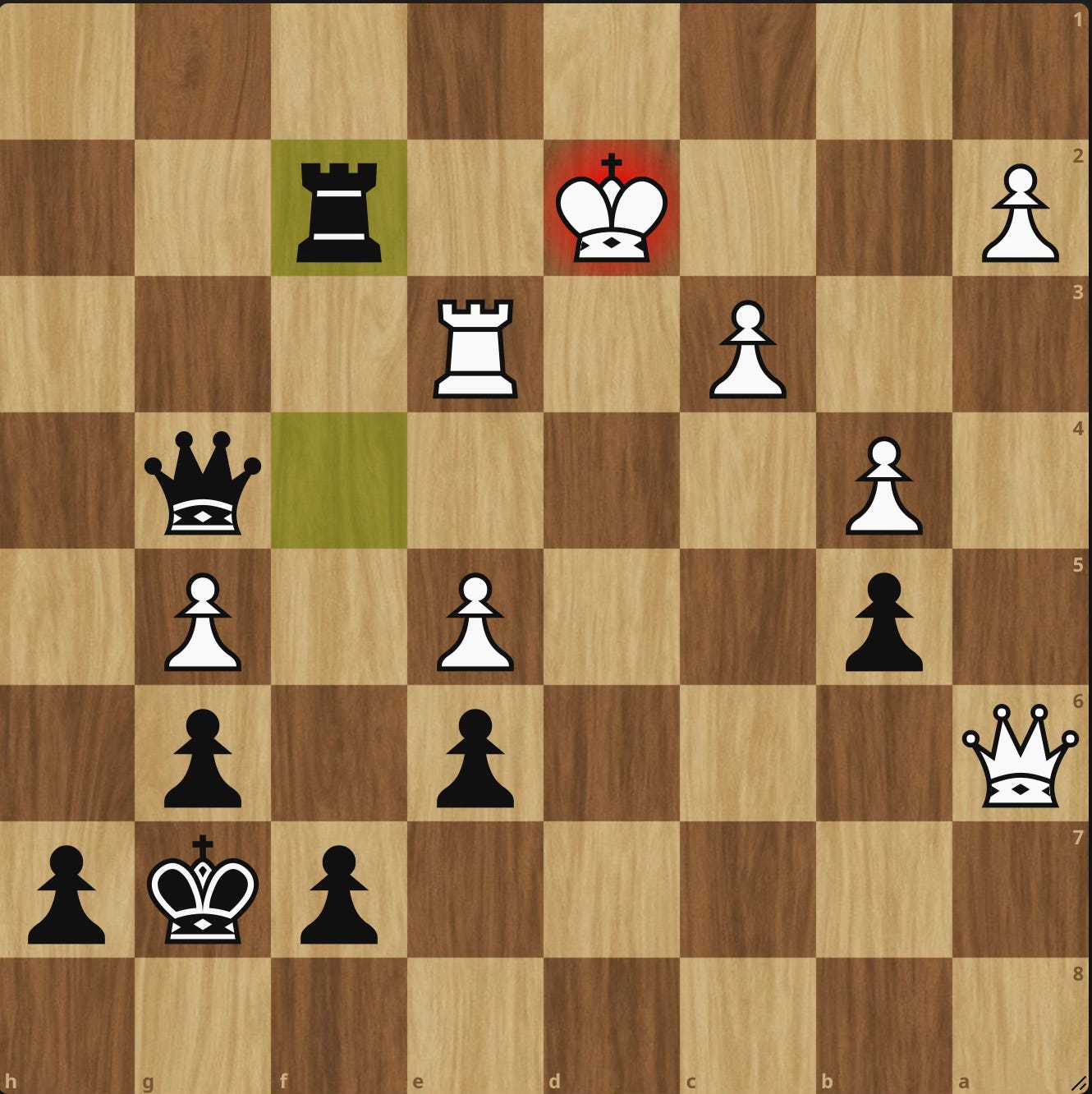
I was fortunate that he made the mistake, but once made I was able to take advantage of it and get a better position. That position allowed me to attack his king and win the game. In the post mortem, my opponent was gracious and I tried not to “teach” much other than to share my thinking in each position and my prep. We went over the game from start to finish and it was my clear impression that I was the better player both from the results and the discussion. Nice for the ego, but it didn’t last long.
“In every victory, there’s a lesson to be learned, and in every defeat, a chance to grow.”
Harvey Mackay
Losing
Game 2 was just a few days later, and it was round 9 in the Lonewolf league. I generally have ratings turned off in Lichess so I didn’t know their rating ahead of time. But looking over their games I noticed they play well. Really well. They had good opening knowledge and, even more foreboding, after the opening they used their pieces really well in the middle and endgames. So I went deep into opening line prep against them. I expected a Catalan and had prepped 14 moves deep against their Catalan. They had lots of games to review and played the same moves each time. I found a flaw in their line and was ready for this position:
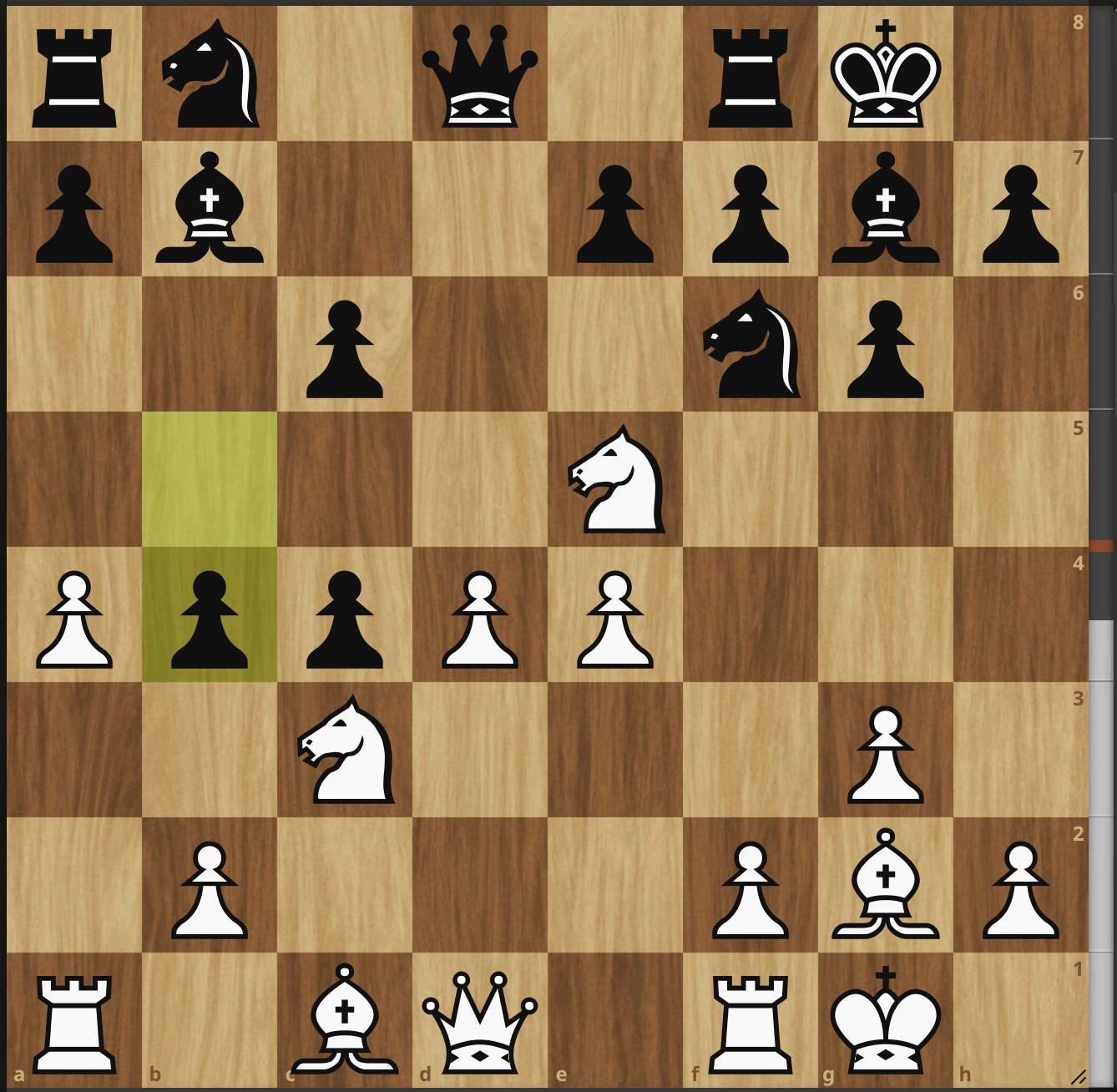
Black is better thanks to the pressure on the Queenside and c5 is coming to break up the center. I was prepped for this line… only to not get it! Instead my opponent went for the London and I played my response from memory. Only I made a series of inaccuracies that led to a fateful mistake. Black to play and keep it equal.
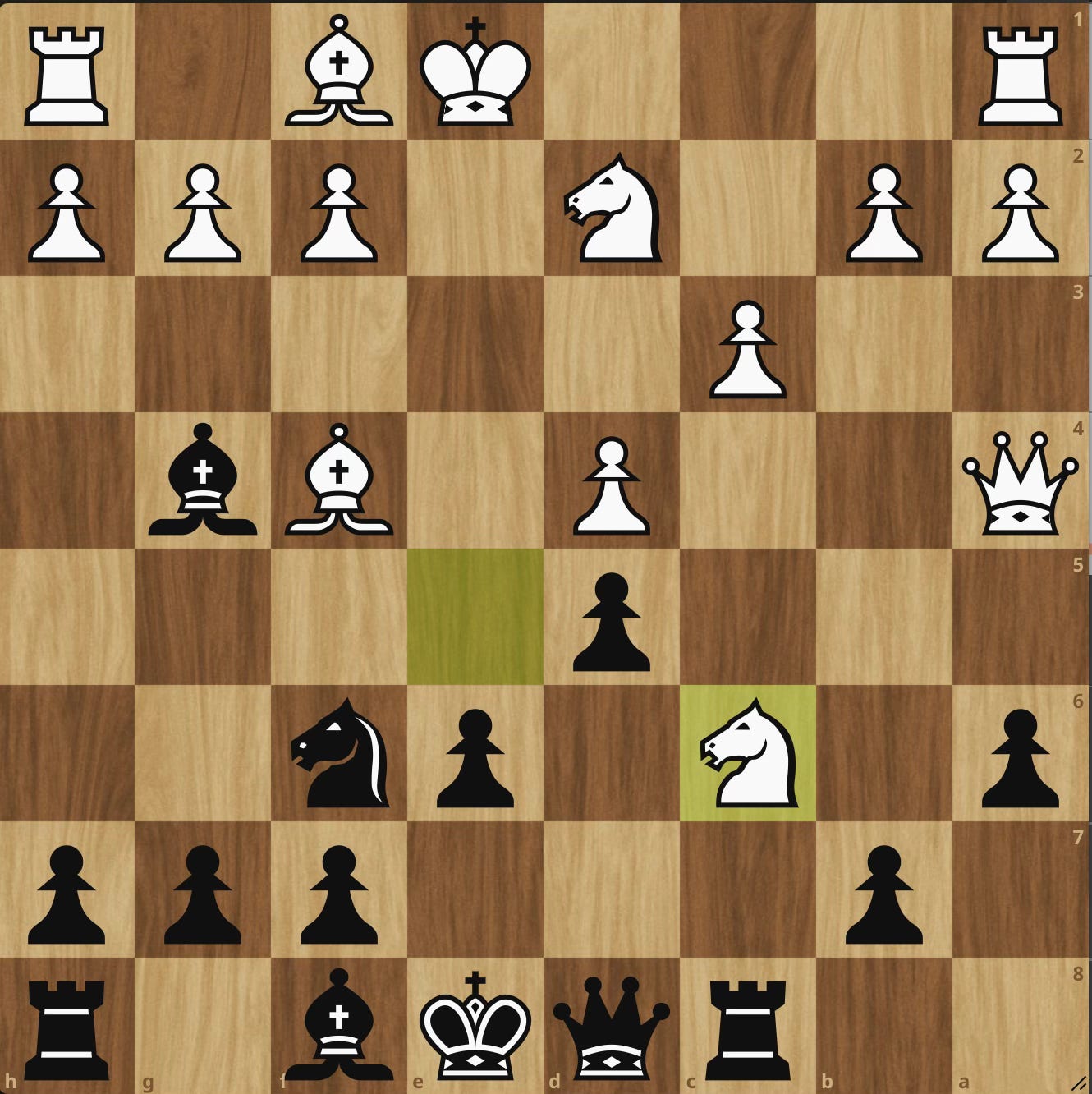
There is only one good move and it is not what I played. After 10…Rxc6 White wins a clean pawn with 11.Bxa6 and then after 11…Qb6 12.Bb5 Black can basically resign. I played on hoping I might somehow come back but it wasn’t to be. The game ended with a knight fork.
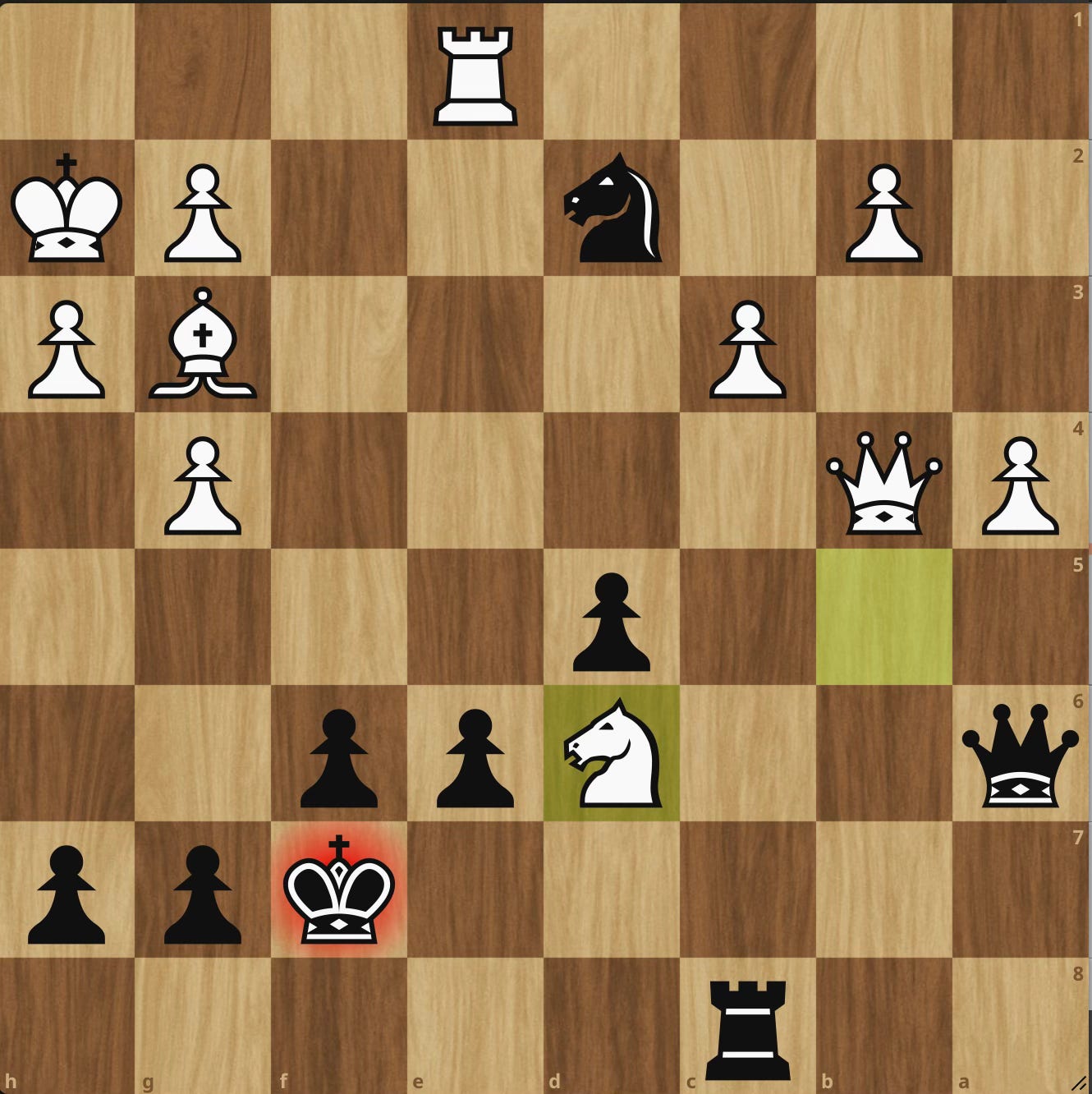
We did a post mortem and it became clear my opponent knew his openings very well. He knew the ideas, the tactics, and he enjoyed studying them. When I asked him why he deviated to the London he said he wanted to change things up for me. What became clear in the post mortem was that he was the better, more experienced player and it wasn’t close. I got insight into how well you have to play to make it to his level.
“Fear of failure is one of the greatest obstacles to personal and professional success.”
Michael Hyatt
Win, Lose, Learn
The critical move in my second game was 10…Qd7! It interferes with the X-ray on the king, pins the knight to the White queen on a4 and keeps the game equal. I never even thought about it. I had committed to my move Rxc6 before the knight was captured, not considering any alternatives. Apparently this is what amateurs do.
In the podcast Hidden Brain, a recent episode focused on trusting your doubt, there was a line that struck me. The difference between a novice and an expert is that the novice treats their intuition as the answer. The expert treats it as the beginning, or a hypothesis. For my chess this is absolutely true. However, what’s odd is that for Emergency Medicine it is not. While practicing EM I can always keep in mind I might be wrong. While playing Chess, my mind finds this thought so overwhelming that I work very hard to find the right answer… often to miss something simple like Qd7.
I find this strange that in one arena I should be so comfortable with risk and in another I am not. What I teach the residents about EM however is the answer to this dilemma. Very simply, you have to risk being wrong. There’s no other way to train your intuition other than to use it and risk failure. That’s why we do residencies, so trainee doctors can fail without truly harming patients. All we ask is that they learn from their mistakes. Personally many doctors find this emotionally challenging and have significant self doubt. It is a source of burnout and a reason why people leave the profession. However, no one is ever perfect and no one is right 100% of the time. We just have to get used to taking risks and making decisions in uncertainty to become expert physicians. Today I’m arguing the same is true for chess.
The Indispensable Role of Risk
Losing in chess just plain sucks. I spend no small amount of time learning this game and to then get wiped off the board is beyond draining. My ego likes winning much better than losing. However, I get better faster when I lose to higher rated players. Josh Waitzkin called it “Investing in loss.”
In game 1 it turns out I was about 200 points higher rated and in game 2 I was about 200 points lower rated. I went from being the teacher to the student. From being the stronger player to the weaker one. I learned something from the win but I learned a lot more from the loss. The emotional toll of losing makes it real.
I wish we could just hole up in our libraries or offices and study chess endlessly to gain knowledge and come out ready to play. That’s not reality for anyone. We need to play first. We need to take risks. We need to lose.
There is no winning without risking loss. There is no learning without losing. Losing shows you that this game is for real. I’m sure you stopped playing checkers or tic tac toe as soon you had “figured out” the game. Chess is appealing to me specifically because it’s hard to figure out.
What these two games showed me is that losing is the only way to win more. I just wish it hurt a little less.
Thanks for reading until the end. I hope this was helpful. Leave a comment and until next time, good luck in your games!
I'm a hospital doctor too. I often panic and do something stupid when I get lowish on time in classical chess, sometimes starting when I have more than 10 minutes on the clock. This quite literally NEVER happens when I am at work, no matter how desperate the situation. There is an important lesson here, and if I can work out what it is I might be able to improve at chess...
"Very simply, you have to risk being wrong. There’s no other way to train your intuition other than to use it and risk failure."
This was a hard lesson to learn -- I feel like I had to come to terms with this over a period of two years, and just started figuring it out last year when my rating bottomed out.
There comes a point where you have to trust your intuition (and search deeper according to its suggestions). It's not always correct, but with more time and experience and wisdom, it is usually trustworthy and I think some players (like myself) hold themselves back by trying to calculate it all and only going forward when they're 100% sure (and most of time time, in complicated positions, we simply can't be that sure).