
Making The List
How to speed up improvement by making a List of Mistakes

Welcome back to Chess in Small Doses, a Substack about adult chess improvement.
Today I’m returning to the topic of mistakes. We all make them, and they always feel painful. In his excellent book Pump Up Your Rating, GM Axel Smith recommends creating a “List of Mistakes” after analyzing your games—but he leaves the exact method up to the reader. For me, simply classifying mistakes was a challenge. I now believe there’s a much easier way: you need only an eval bar, two basic categories of mistakes, and three root causes. Let’s dive in. (There is a TL;DR at the end since this post is long.)
Why Bother?
The consensus is adult improvers should analyze our own games. Almost every game contains moments where a player makes a mistake (otherwise it’s just a draw). The promise of analysis afterwards is that mistakes are revealed and, hopefully, this results in improvement. However, analyzing a game is only the first step; players should also keep a List of Mistakes.
Keeping such a list helps us to identify recurring errors and (hopefully) stop repeating them. Good analysis shows what a better move looks like, teaching us to think like stronger players. It provides essential feedback for players of all levels and, ideally, creates an improvement loop in which we make fewer and fewer mistakes.
Every player has strengths and weaknesses. I think strengths set our ceiling and weaknesses set the floor. Last year, Dan Bock highlighted how often “advanced” players still make basic errors. He echoed a passage I read in the Steps 5 Trainer’s Manual:
“Replaying the games of children on Step 5 level is quite disappointing. Students make too many mistakes that actually should not appear at this level any more. (…) Of course there are gaps in the student’s knowledge. Those omissions - a word which sounds a bit nicer - must be eliminated and that is the task of the trainer. (…) Concentrating on providing new knowledge only increases the gaps and they quickly become chasms.”
Step 5 supposedly correlates with players up to roughly 1950 ELO—strong amateurs. I reached Step 5 in 2022, yet my actual ELO lagged behind. I could solve challenging puzzles, but playing a mistake‑free game was another thing altogether. No matter how hard I tried, those gaps persisted.
Barriers
One reason why improvement through analysis can be difficult is the lack of consensus on what actually belongs on a List of Mistakes. Online you’ll find countless “common chess mistakes” lists (see here, here, here, and here) and several books on the subject (see here, here, and here). Frustratingly, these lists show very little overlap. Beginner mistakes are easy to spot, but beyond that the terrain becomes murky. Chess is too variable for a one‑size‑fits‑all checklist. Without a clear picture of our actual issues, improvement is a challenge.
Previously I analyzed over 111 classical games on my own using an engine. I really struggled with how to classify mistakes. As an admitted over-thinker this sent me into the weeds trying to label each mistake. The result was interesting, but not exactly helpful. I learned I needed to get better at tactics and calculation- yet I wondered if I really needed analysis to see that?
Perhaps this result shouldn’t be surprising. We’re not meant to analyze alone. GM Alex Smith’s writes in Pump Up Your Rating:
“It’s difficult to analyze a game on your own, since you need someone to discuss it with. Ideally you have a trainer or another player who is at least as strong as you are, but that is a bonus. Any training partner is better than not having one.”
For many adult improvers, the partner is a coach whose sessions often last an hour or more per classical game played. That’s a significant commitment of both time and money. Others are fortunate enough to have a training partner (pro tip: a post‑mortem with your opponent counts!). Ideally that partner is a stronger player who can teach you. If you have a partner, great—analyze together! Analyzing is a skill that takes time to develop. Learning it from someone else really helps. However, not everyone is so lucky. If that describes you, I have a solution for you.
“You learn to love mistakes once you realize you learn faster with them.”
Maxime Lagacé
Step 1 - Find the mistakes
If, like me, you’re often analyzing alone then let me suggest to train with the strongest player in the world: the engine. The engine is always available and is damn near omniscient. The biggest drawback is it never explains itself in plain language, speaking in concrete lines. Another drawback is that we “fail” to develop as chess players when the engine tells us the evaluation. However, if I am to be honest I believe that few if any of us are actually analyzing and learning the old way. I suspect most of us are already using the engine. So it may be heresy, but I think we can marry the engine’s strengths with the process of self-analysis and still develop intuition.
The Setup
Turn ON the engine.
Enable the Evaluation Bar.
Turn OFF the Best Move Arrows.
Set Engine Lines to 0/5.
This set up gives us the engine’s hyper accurate calculation ability without giving us the answer. We won’t be able to see what the best move was, just who is better. This last aspect is critical as being told the answer puts our minds to sleep.
When the Evaluation Bar swings dramatically, that’s our cue to look again. Generating curiosity for a position is exactly what we want.
What to Look For
Scan the game move by move and flag any position where the Evaluation Bar changes by roughly ±2 . We really just want the big swings, the dramatic moments. If none occur, congratulations to you (and your opponent)! In most of my games there are at least two or three such moments. Mark each big swing as a “Mistake” and keep going. This first pass is a quick survey; we’ll come back to them later.
Step 2 - Classify The Mistakes
Now we need to try and classify what kind of mistake we made. This is part of the process I got wrong previously and can be where things grind to a halt. We get too far into the weeds trying to come up with an all encompassing list. It will not help. Trust me, this is a rabbit hole we want to avoid.
Thankfully, classifying mistakes is easier and much more helpful when we keep it simple. My argument is that our mistakes will closely mirror our development. Because of that we don’t need multiple and/or specific categories to encompass all phases of the game. We really only have to concern ourselves with two fundamental types of mistakes.
Got It Wrong
These arise when we recognize something on the board but choose the wrong move. Classic examples: miscalculating a tactic or seeing a threat but missing a key defensive move. Call them “oops” moments. For example:
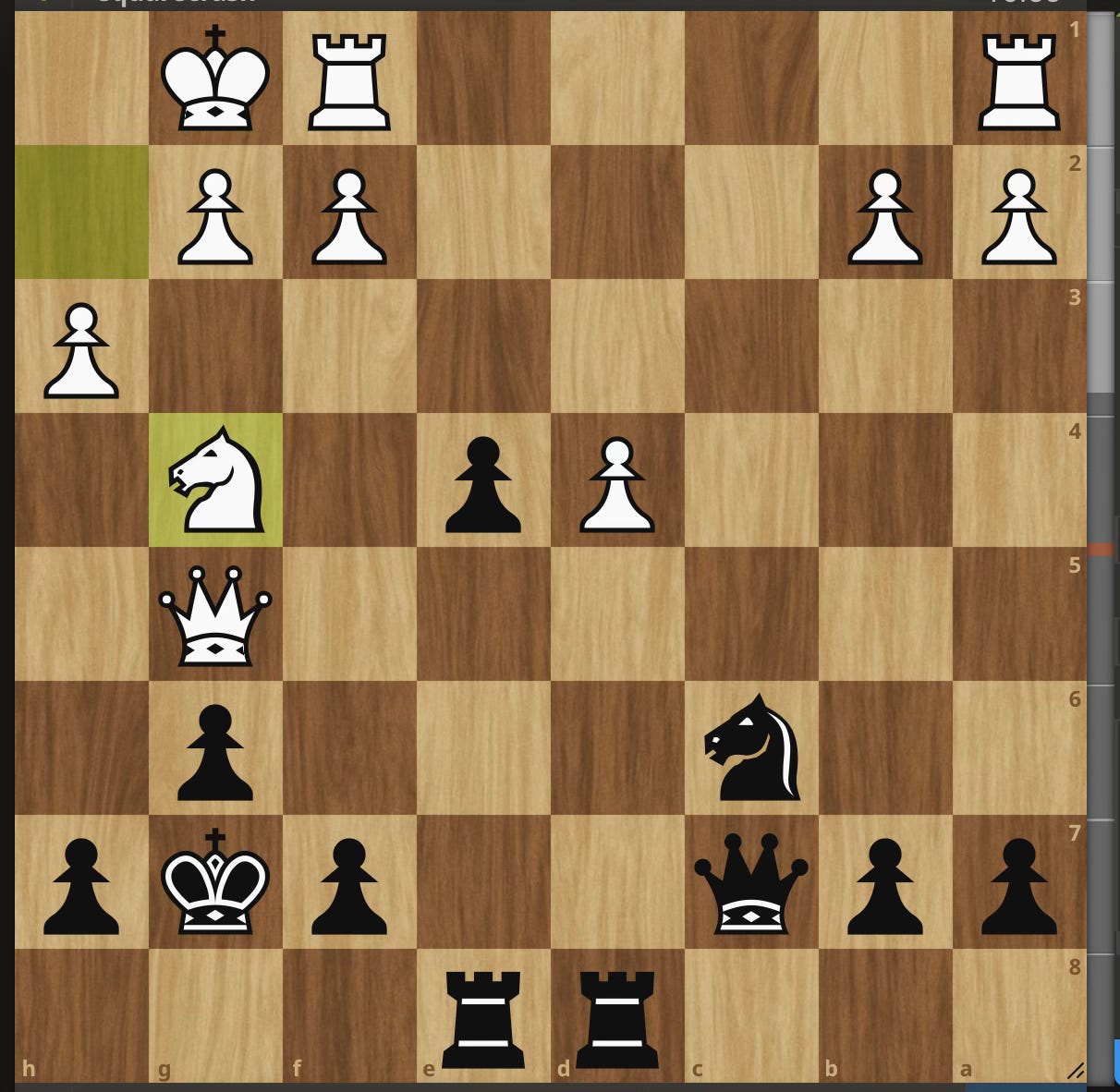
Here the Evaluation Bar shows Black is again winning or ahead. White has played Ng4 with a threat of Qh6+ or Qf6+. I saw the threat, but miscalculated thinking I had time to take a pawn. I was wrong. I played Nxd4?? allowing mate in 3. Oops.
Didn’t See It
These are the blind spot errors we completely miss. They’re the most valuable to study because they expose the gaps in our board vision. The engine’s Evaluation Bar highlights them, but we turn off the engine lines so we’re forced to find the missed idea ourselves. For example, here’s a moment I missed.
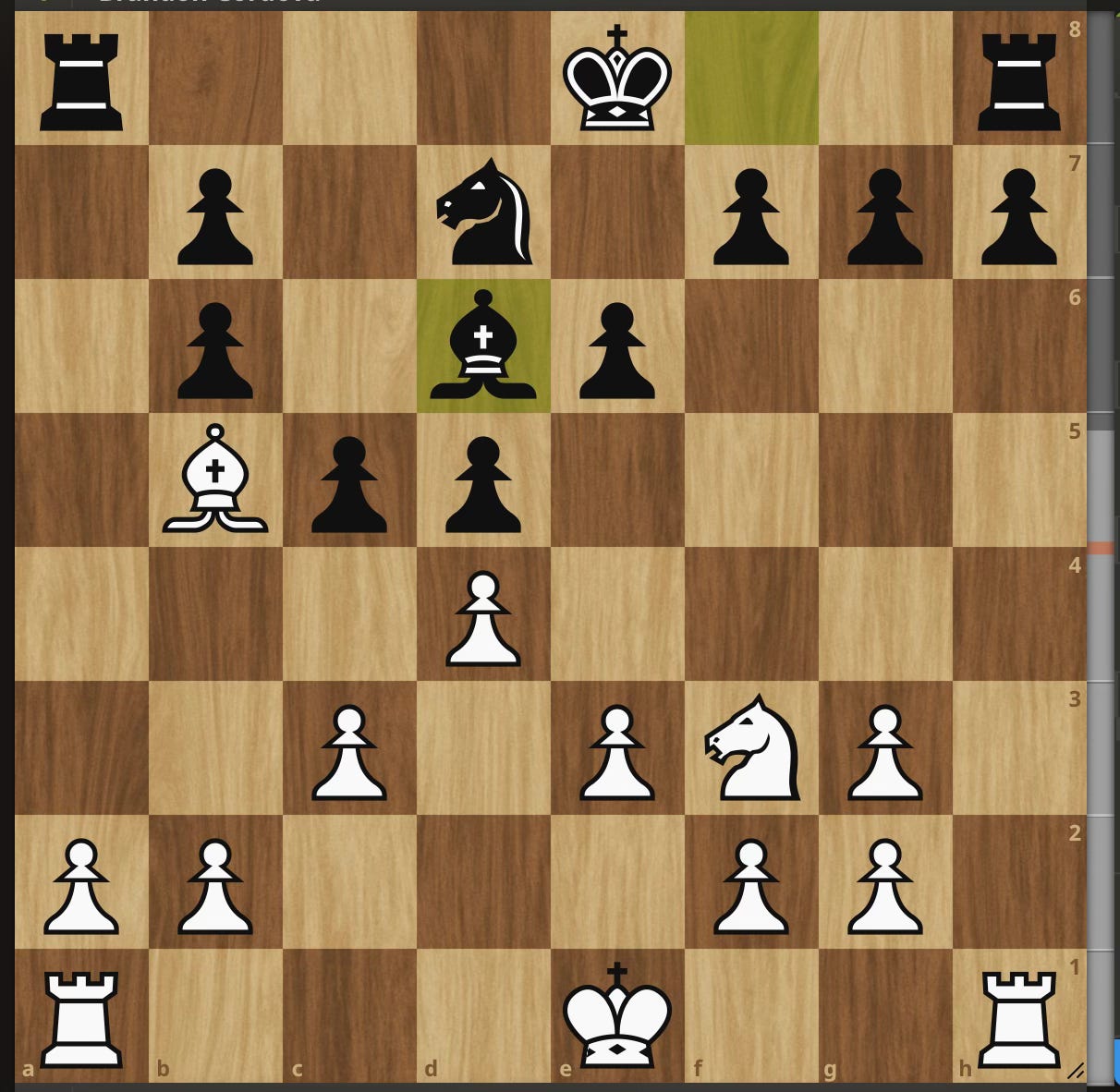
The Evaluation Bar shows White is ahead, but I didn’t realize it. I played Ne5?? and the evaluation went back to even. I missed Ng5! which turns the King into an overloaded defender. If Black plays Rf8 then Nxh7 wins a pawn. If instead Black plays O-O-O then Nxf7 forks the rooks. Ke7 is best but it allows the forcing line Bxd7 Kxd7 Nxf7 winning a pawn. I never saw Ng5 as an option. Only by testing out candidate moves did I find it.
For each flagged mistake, decide whether it falls into “Got It Wrong” or “Didn’t See It”. Simply labelling them already gives us some self‑awareness; but we’ll go deeper in the next step.
“If one doesn’t know his mistakes, he won’t want to correct them.”
Seneca
Step 3 - Assign a Root Cause
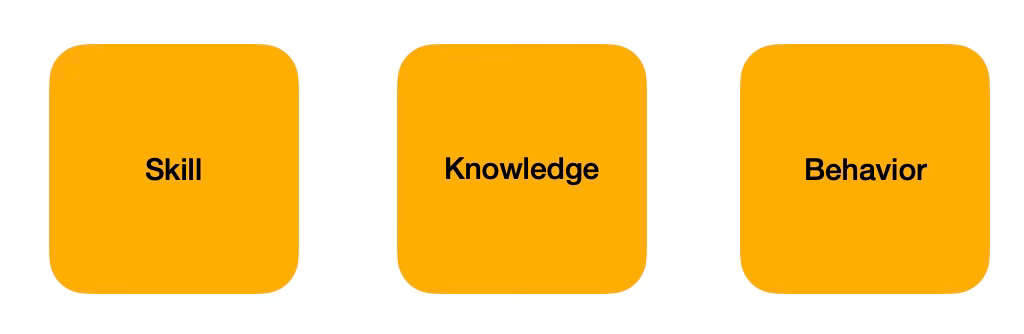
Now that we have these two basic categories, let’s talk about finding the “why” or the root causes. Finding the root cause can be another exercise in confusion for improvers. There’s no way for us to know what we don’t know. My former coach suggested the 5 Why’s exercise to get at the root cause, but I always struggled with it. Again I think we can make it much simpler. I believe there are only 3 root causes we need to concern ourselves with: Skill, Knowledge, and Behavior.
Skill
Skills gaps can include mistakes of visualization, calculation, and evaluation. Most if not all adult improvers will likely have an “omission” in their skills that will show up in their games. I’ve played more than a few “brilliant” tactics only to be shown the error of my calculation.
Knowledge
Knowledge gaps include opening theory, endgame theory, mating patterns, tactical patterns, and positional motifs. Essentially any and all common patterns can cause a knowledge gap. Unfortunately these kind of gaps are blind spots and they are only revealed by playing first, studying later.
Behavior
Anything that doesn’t fall into Skill or Knowledge then falls into Behavior. Since chess is a game of timed decision making, anything that influences our decision making or use of time would be put here. For example, my biggest issue is playing too fast and not always looking to see what my opponent will do in response. That’s a behavior that causes many mistakes for me.
Finding The Cause
Now that we have the 3 root causes, give some thought as to which one caused each mistake. I believe that which mistakes we make doesn’t matter nearly as much as why we make them. The real benefit of doing analysis and making a List of Mistakes is to learn what we need to work on most. Since many of us have blind spots, I have found the process of analyzing on our own will leave them hidden. Finding the root cause is the whole point of a List of Mistakes. Again I think we can keep it very simple. Let me suggest the following division:
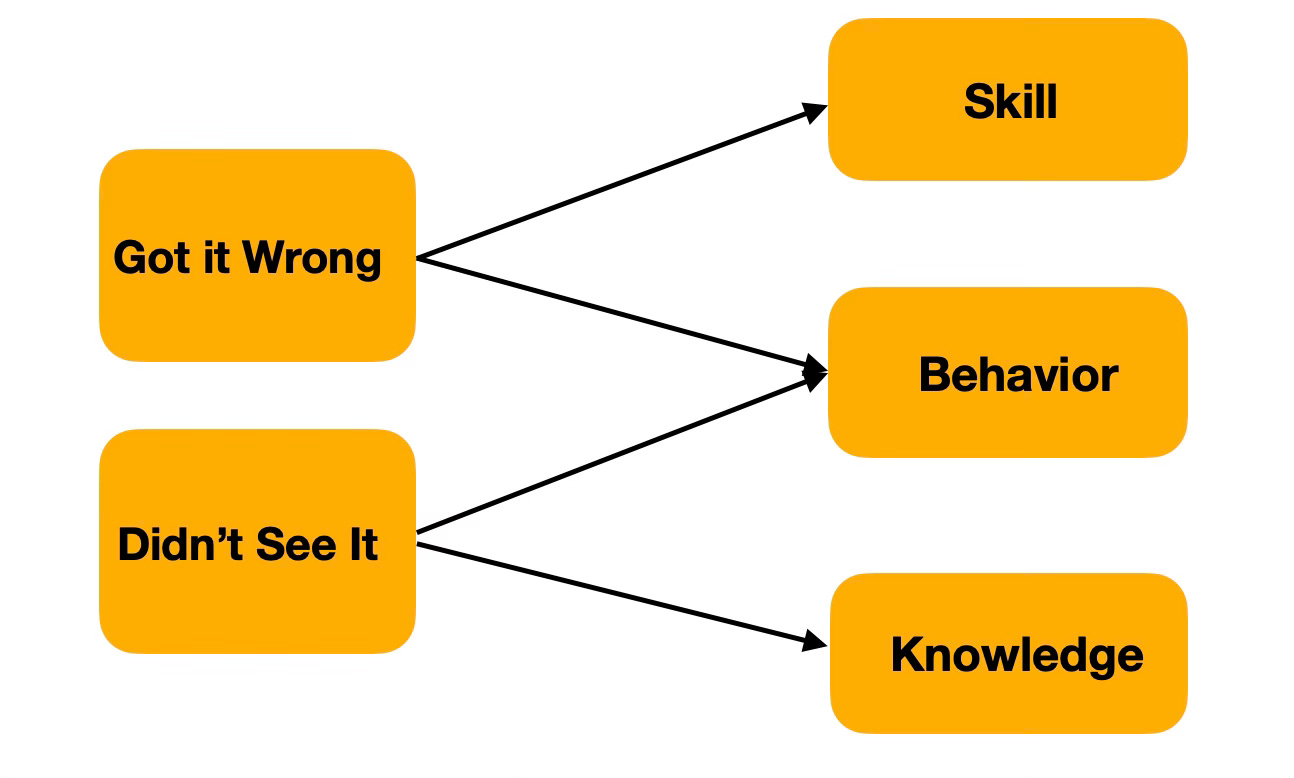
Got It Wrong → Likely a Skill gap (mis‑calculation) or a Behavior issue (rushing).
Didn’t See It → Usually a Knowledge gap (unfamiliar pattern) or a Behavior issue (not scanning thoroughly).
You are best positioned to judge which cause fits each mistake. If you want to get more detailed or granular, feel free, but these 3 categories will often be enough.
“Life teaches us through our mistakes.”
Haemin Sunim
Fix the Problem, Not the Blame
A List of Mistakes is pointless unless it drives improvement. As the list grows, the dominant “bucket” of errors will emerge. Focus only on the big swings, not the endless minor inaccuracies the engine will find.
Drawing from my experience as a physician, I see parallels: we master medical knowledge, then practice, constantly learning from painful errors. Chess improvement follows the same pattern—identify the root cause, then apply the appropriate “treatment”.
Adopt a growth mindset: treat mistakes as the best pathway for progress. There’s no point in getting upset when mistakes happen, although I still do. All I can hope is that we apply a growth mindset and look at our mistakes as our best chance to improve. Adult improvers are often professional at something else other than chess. Our time for chess study is limited. The List of Mistakes can help us focus on the most immediate issues we have provided we are willing to look at them.
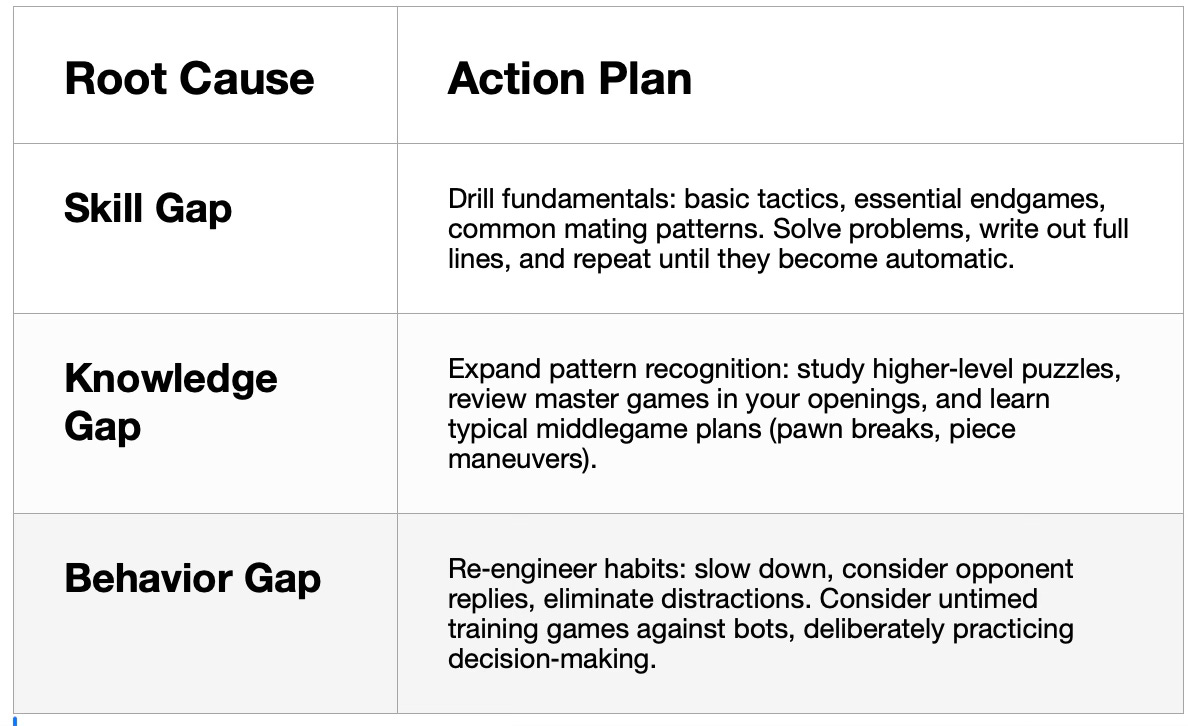
Skill Gap
If we’re getting things wrong often due to skills, then we must work on improving our chess fundamentals. Simple things like basic tactics, basic endgames, and common mating patterns can help. When we solve problems, write down all the relevant lines we can see. Practice them until we can do them in our sleep. As our skills get better, we’ll raise the floor on our play and be less wrong more often.
Knowledge Gap
If we’re missing things often due to knowledge gaps then we must work to improve our pattern recognition. Tactical patterns are often hidden in complex positions. Similarly we may know our openings but not know the common middle game plans (aka pawn breaks) from there. Deepening our knowledge and recognition of mating patterns, tactics, and strategies will be the answer here. Try using more difficult tactical puzzles. Or review master games in our openings to find their plans. The answer will come through deliberate practice of more challenging material to raise the ceiling on our performance.
Behavior
Behavior gaps might just be the most difficult to change as the issue isn’t knowledge or skill, but very likely habit. After analyzing multiple games, you’re likely to find common behavior patterns. One of mine for example is I tend to move before considering my opponent’s best reply. What ever the behavior is, changing begins with an identity and some practice. In my case, I want to be a deliberate chess player who considers every move. Training games are a fantastic way to try out this new chess persona. I’ve chosen to use casual untimed games against bots to train myself to always be comparing. It’s a work in progress, but changing behavior can’t start until we acknowledge there’s a problem.
Wisdom and Judgement
It’s said that wisdom (or good judgment) comes from experience. Experience comes from mistakes (or bad judgement). Chess is a tough game where our shortcomings are shown to us often. It can be emotionally hard, but if we take a growth mindset we can use a simple process to identify our biggest gaps and take steps to close them. Everyone has strengths and weaknesses. Everyone. The opportunity comes when we’re willing to look at them with a List of Mistakes.
Thank you for reading and please leave a comment, tell me what you think and if you agree or disagree.
TL,DR
Making a list of mistakes from analyzing our games gives us insight and helps us improve. The protocol I’m suggesting we use is:
Analyze our games using the Engine evaluation bar only (no engine lines, no full engine analysis)
Look for moments in the game where you either
Got it Wrong; or
Didn’t See It
Assign root causes using your best judgement
Skill gap
Knowledge gap
Behavior Gap
Train whatever gap is most immediate
Skills → Fundamentals
Knowledge → Pattern Recognition
Behavior → Habits
This is an area I have been trying to figure out, too. Your suggestions make the process simpler even though I still have trouble being objective about the "why" ... I can attribute pretty much everything to a lack of skill -- like attributing all causes of death to heart failure. :-)
Thanks for the post!
When analysing with lichess and trying to figure out why your move was wrong a useful trick is to go back to the opponents previous move (before your mistake) and press the threat button (looks like a cross hair) in the lichess analysis pane - this will give you big clues together with the calculated lines as to what your opponent's threat was esp. if not immediately obvious
Fantastic article btw - I am working through Dalton's related article trying to see the mistake patterns in my games this season - it's very interesting