
Mind The Gap
Analyzing my last 20 classical games to make a List of Mistakes

Welcome back to Chess in Small Doses, a Substack about adult improvement in chess. Last time I wrote how to make a List of Mistakes. I used an abbreviated, engine assisted process to classify mistakes and their root causes. To put my money where my mouth is, I analyzed my last 20 online classical games in this way. The results were surprising. Turns out I’ve got pre-move issues, have blindness to some patterns, and could use some more basic endgame knowledge. Let’s get into it.
Methods
As I wrote last time, keeping a List of Mistakes is generally thought of as the best way chess players can find their common mistakes and weaknesses. The problem of analyzing games on our own is we remain ignorant of our blindspots. To reveal them I used the simplified process where I:
Turn on the Eval Bar
Turn off engine lines and best move arrows
Mark mistakes on +/- 2
I went through each game I played and assessed each move. For the moves that qualified as serious mistakes, I tried to assign a mistake type and then a root cause.
Mistake Types
Got It Wrong
Didn’t See It
Root Causes
Skill
Knowledge
Behavior
I put the last 20 classical games I played into a study on Lichess available to see if you wish. All 20 games met Classical time control according to Lichess. These included 30+30 and 45+45 but also 30+0, 25+3, and 20+10 which all qualify as “classical” but feel very different when playing.
I put comments in for each mistake, made a few variations, and a occasionally some conclusions at the end. The analysis was done not for posterity, so please forgive me if the words are either short or seem confusing.
Also, I marked a few moves at mistakes even though they fell under the +/-2 level. A loss of 1.5 seemed significant to me in some of the positions.
Lastly, if my opponent made a serious mistake and I noticed it, occasionally I’d give myself a pat on the back with a good move notation (using the ! symbol).
Let’s talk about what I found.
Results
First off, let’s look at the mistake types:
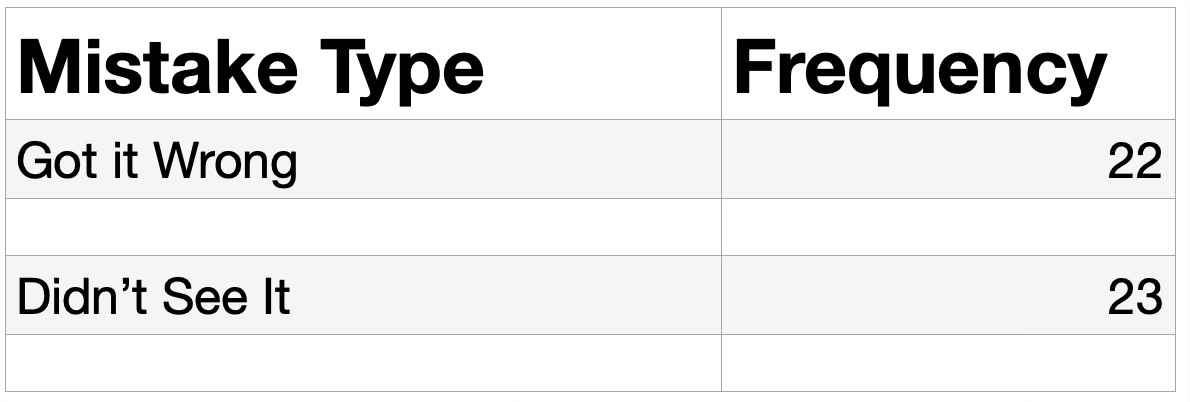
There is an even distribution between the two. I’ve had just as many mistakes occur when I saw something in the position as I did when I was blind to it. Also, the rate of serious mistakes I make is about 2.25/game. Perhaps not too surprising given my rating level. The issue however is that it’s not at all clear what I should do to reduce that mistake rate. To find that we need to look at the root causes: Skill, Knowledge, and Behavior
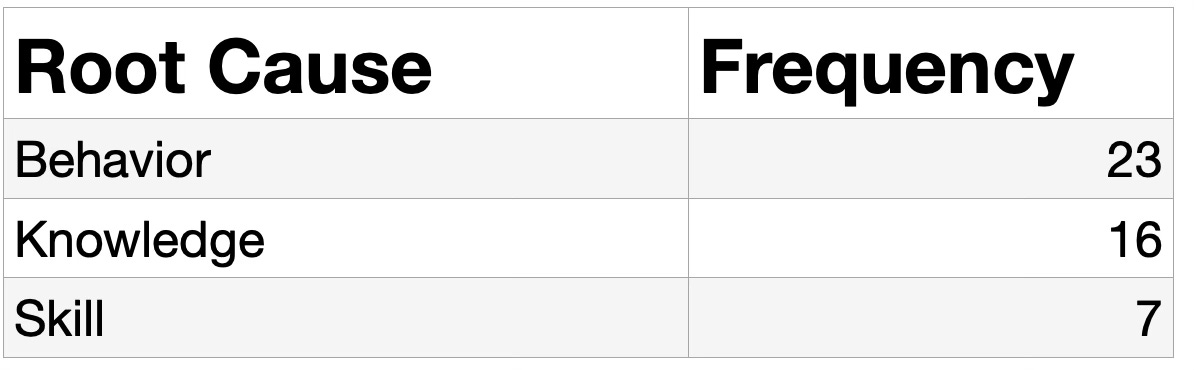
OK, now we have a trend. The most common mistakes I make are behavioral. The second major cause of my mistakes came from a lack of knowledge of some common patterns. A distant third was actual skill when calculating moves.
Behavioral mistakes are the most common for me, and the #1 issue is moving too fast. I have a bad habit of simply “see move, make move” that has been an issue for a long time. By “too fast” I typically mean less than 30 seconds. Sometimes these moves are just fine, but often there’s a better move I didn’t consider. Here’s a great example.
Got it Wrong - Behavior
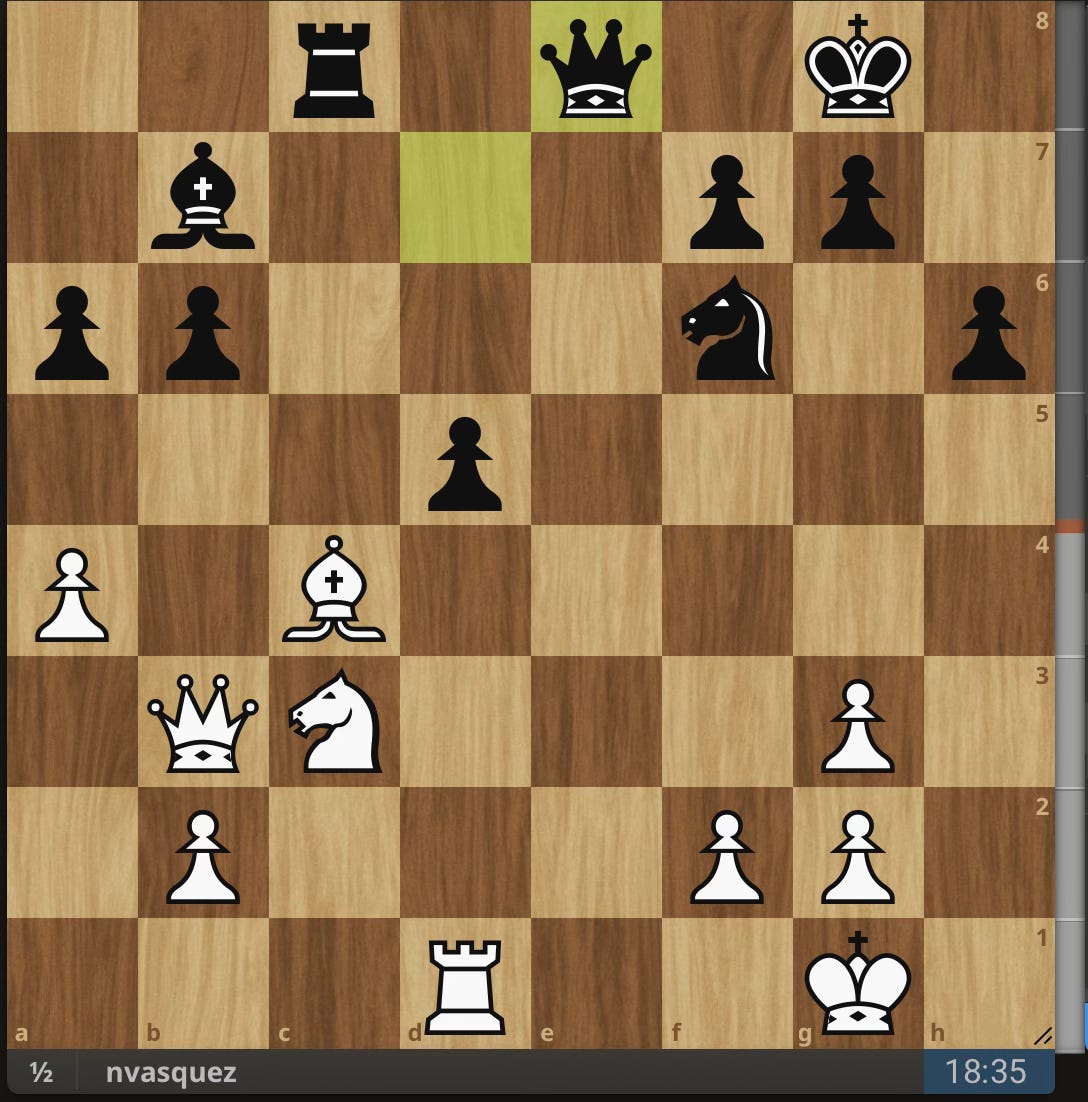
It’s even and it’s white to move. The d5 pawn threatens to capture the c4 bishop. I played Nxd5?? in under 30 seconds. I went from 18:35 to 18:30 on the clock. With that speed I didn’t stop to look at what my alternatives were. I had the option of Qxb6! which keeps things equal. What I also missed was that Nxd5 Bxd5 Bxd5 Nxd5 Rxd5 allows Qe1+ and then Rc1 is killer. Thankfully so did my opponent.
Missed It - Behavior
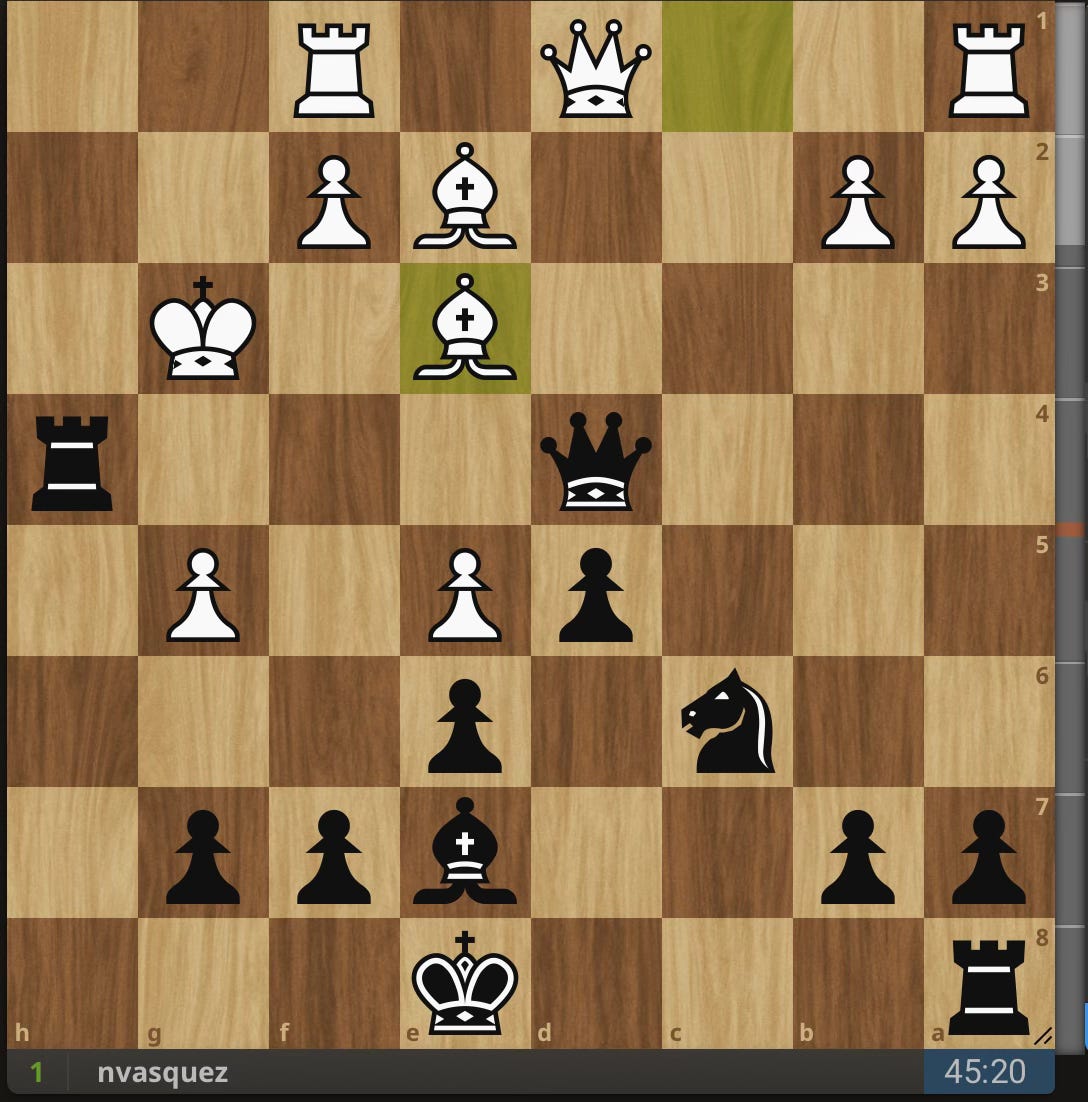
Here’ Black is winning and has a simple reply. However, I played Qxd1? very quickly. What I missed was 1…Qxe5+! is a trap for White. If 2.Kxh4?? then Qh2+! Kg4 Ne5#. I missed it because I played my move so fast I added 30 seconds to my clock in a 45+45 game. Yikes.
The second common source of mistakes was blindness to common chess patterns (aka Knowledge). Here’s a great example:
Missed It - Knowledge
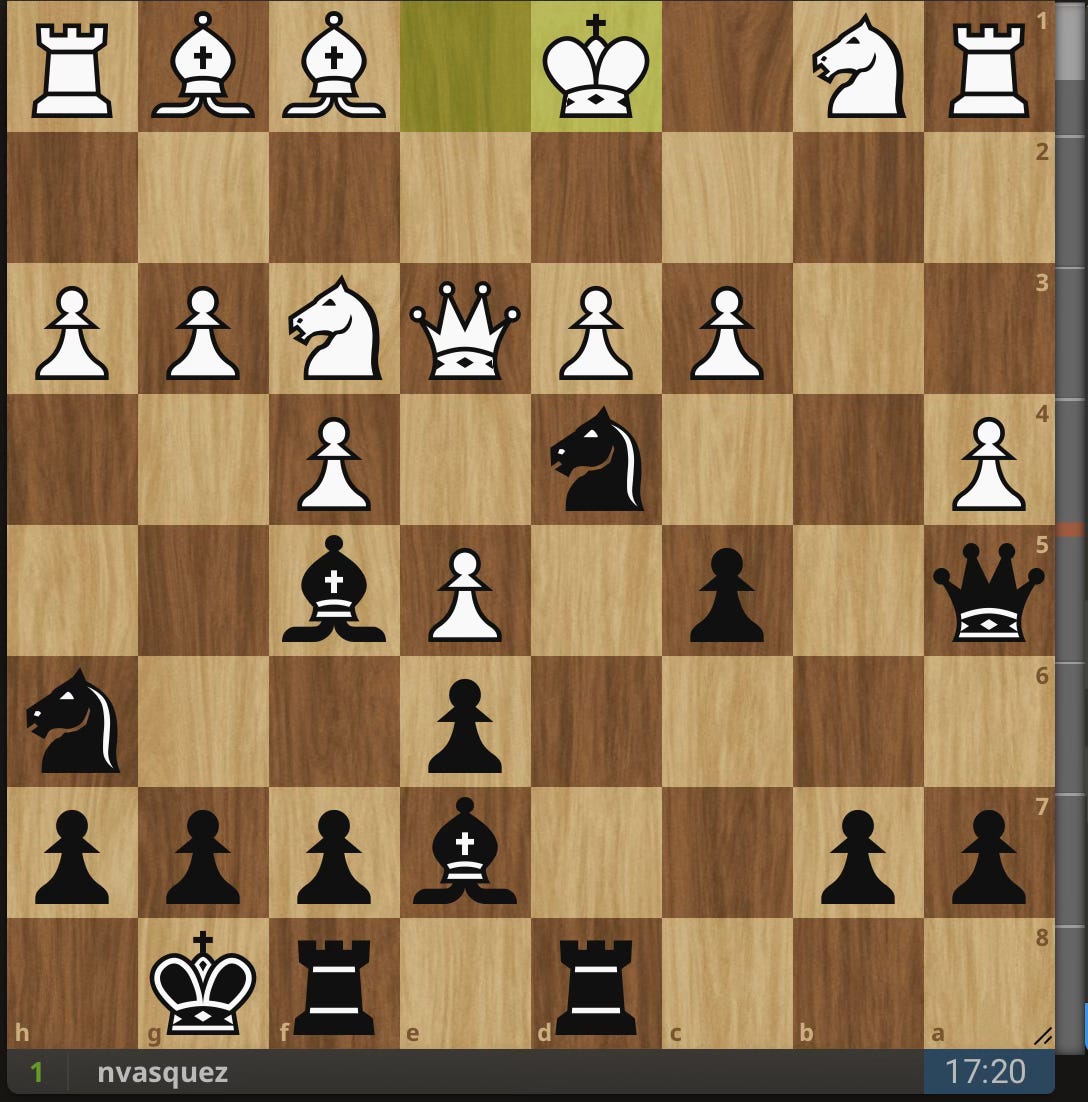
It’s Black to move and I’m way ahead with lots of time. However after Nxf3? I’m only a little ahead and have given away much of my advantage. I looked at alternatives and had taken my time to consider them. What I was blind to was the x-ray in the position. In fact, blindness to X-ray tactics showed up surprisingly often. The depth of this tactic is about 5 moves deep but I probably could complete it if this were a Step 5 or 6 tactic. It starts with 1…Nb3 (gaining a tempo on the rook, clearing the line) 2.Rb2 Bxd3! 3.Bxd3 After that Black has the option of either Nf5 or c5 but Rxd3+! is most forcing. It was hard for me to see but opening the position, removing defenders, and bringing attackers to the king is something the Steps Method teaches. Yes it’s challenging, but this is a sort of tactic that I can solve when I know there’s a tactic. It’s also something you can potentially work out once you see the pattern. This blindness to patterns in a position showed up often in my analysis.
Here’s another example:
Missed It - Knowledge
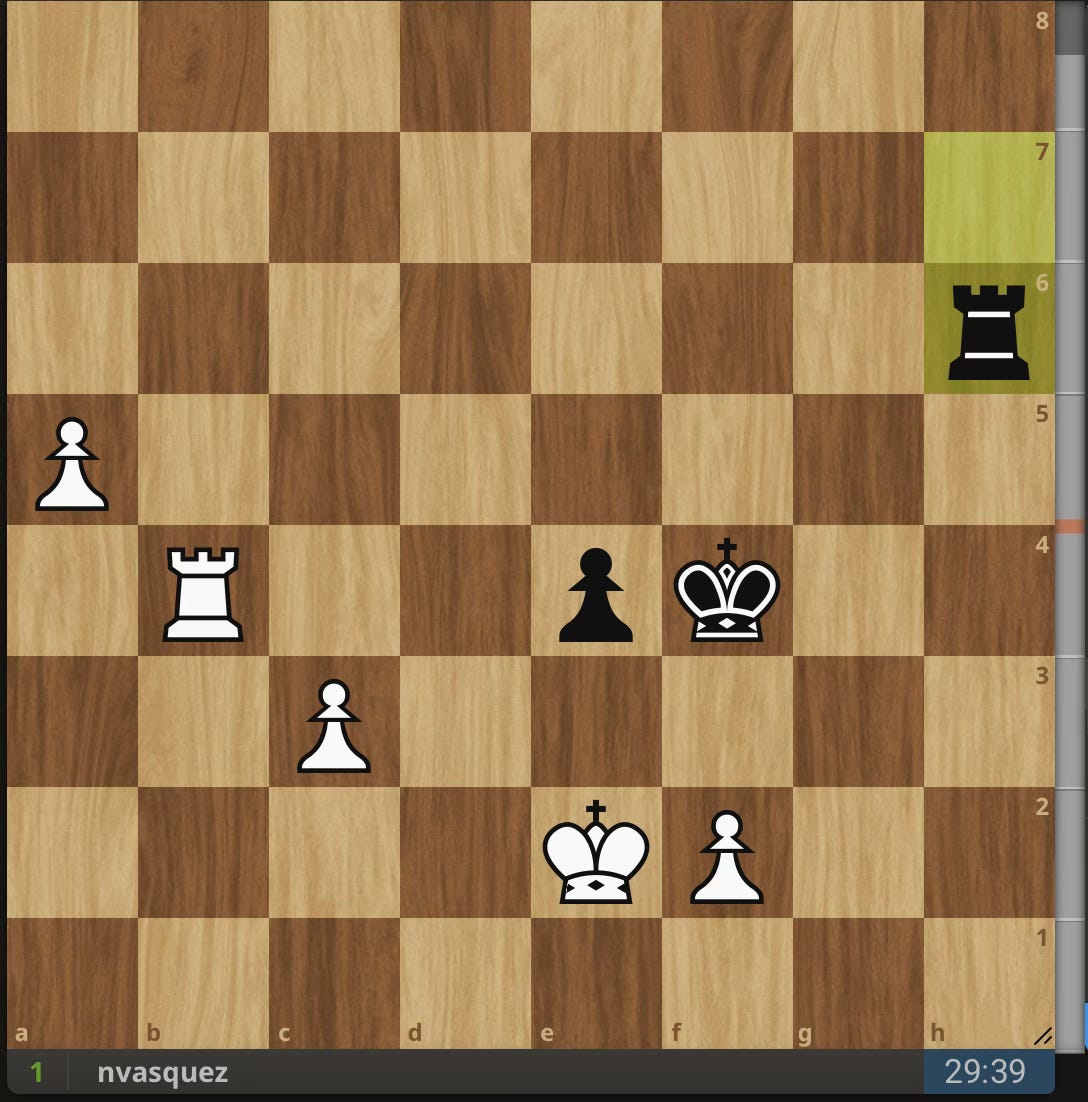
It’s an endgame and White is winning. One simple move secures the win for White. However, I didn’t really know the theory and played Rb6? instead. Endgame theory says that “rooks belong behind pawns” meaning Ra4 was the best move here. This was one of many endgame positions that I had mistakes in.
Occasionally skill would be a source of failure, but much less often. Here’s an “oops” moment I had.
Got it Wrong - Skill
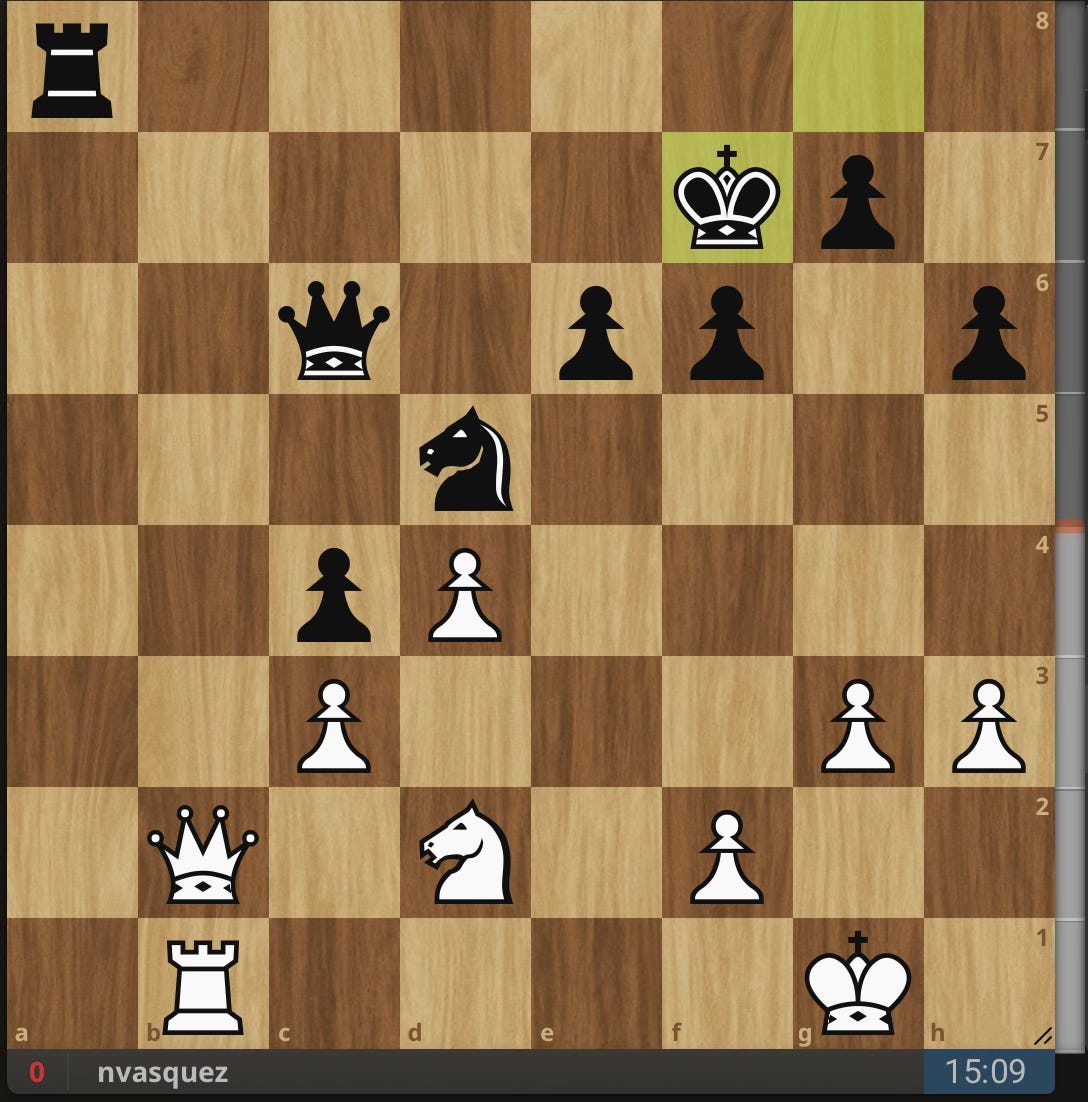
I had 15 minutes left and I thought I saw a tactic. I spent several minutes calculating Nxc4?? since Qxc4 Qb7+ leads to a fork between the king and then rook on a8. I got it wrong since I didn’t look for defenses, only to be surprised when my opponent played Nc7! defending the rook and blocking the check. Oops.
These kind of mistakes are painful but thankfully they were rare. I believe that’s due to the training I’ve been doing focusing on basic, simple tactics.
Discussion
What I learned was that I have three major causes of error:
Moving too quickly to complete a pre-move checklist,
Not seeing tactical patterns in many positions (especially X-rays), and
Incomplete knowledge of endgame theory
Behavior change is challenging. It’s not just about knowledge, but also emotion and identity. I will need to establish and ingrain a habit of a pre-move thinking process. I’m comfortable using the thought process I wrote about previously to slow myself down. The recurring issue is that in competitive games however, I often feel like I’m running out of time and need to speed up. That directly led to moving “too fast” and failing to look at other moves. It often feels overwhelming to search for options every time. It’s almost like I lose the mental stamina (or maybe never had it in the first place as most emergency workers display ADHD traits).
The “fix” is to repeatedly train a basic pre-move thought process until I do it automatically. I’m going to experiment with casual games against bots. These allow me to train a pre-move habit repeatedly in a practice environment without the pressure of the clock. Resources include
Maia9 on Lichess
some free bots on Chess.com
I’ll write about it later as I experiment with each.
Beyond that, I was surprised to find that some tactical blind spots were common, especially to Xray tactics. Improving tactical and positional vision is really just about deliberate practice to improve the ceiling. Instead of just basic tactics, I will add in more challenging ones now to raise my ceiling. My resources include:
Lichess also has themed tactics available for free.
Lastly, endgame knowledge was an all too often source of errors. I saw I had a tendency to convert winning endgames into draws. Not good but very fixable. Resources for this include:
a basic endgame Chessable course
and even a huge Polgar book. Did you know Susan Polgar wrote an endgame book?
Conclusion
After analyzing 20 games with an engine assisted process revealed three common problems for me. I sometimes move too quickly to compare moves. I am sometimes blind to tactical patterns especially X-rays. I have a surprising lack of knowledge of endgame techniques. Recognition of these recurring mistakes has already helped me make some changes to my training plan. I will practice a simple pre-move check list, study and train endgame theory, and use deliberate practice to improve tactical pattern recognition. The List of Mistakes has given my training a specific focus on what I struggle with the most.
Thanks for reading. I hope this process was helpful. I would love to hear what you find if you do your own analysis. Until next time!
This approach sounds useful but it does miss an important category of human mistakes. I'm talking about moves that lead to difficult to play positions even though the engine eval is fine. Or, flipping it around, missing moves that make it easy for you to keep playing good moves.
Your articles are helpful.
Thinks.