
The Hardest Thing Ever
Thinking while playing chess is the hardest thing ever

Welcome back to Chess in Small Doses, a Substack about adult improvement in chess. Today I’m sharing one of the things I find the most difficult in chess. I know what I’m supposed to do, but often revert to bad habits. How do you stay aware of and guide your thoughts while playing chess? Let’s get into it. (There is a TL,DR at the bottom)
Introduction
In 2007, noted meditation teacher Dr. John Kabat-Zinn spoke to Google Engineers about mindfulness. I can remember finding this video somewhere in 2013 when I became a medical director. The job was more than a little challenging and I was trying to learn how to manage the stress. In the video Dr. Kabat-Zinn talks about starting a stress management clinic in the late 70’s centered on mindfulness. He explained that mindfulness is the ability to pay attention to what’s going on. He stressed that “There’s a lot going on right now.” That line spoke to me because of my job at the time and I bought his book Mindfulness for Beginners. Writing in the introduction, Dr. Kabat-Zinn instructed the reader to meditate every day for two years “like your life depends on it.” That seemed a little dramatic to me at the time but I gave it a try. I think I made it like two weeks before I fell off the wagon. Looking back, now I wish I had stuck with it. Every time I play chess, I get lost in what’s going on right now. It turns out that remaining aware of your thinking while playing chess is the hardest thing ever.
Time Management
The first place that shows up for me is in time management. Without intervention, I often default to moving too quickly (see here and here) and I can end up playing hopeful moves that are often not the objectively best. NM Dan Heisman wrote an article about time management called Two Move Trigger (behind a paywall) and made a YouTube video about it. He wrote that we should think until one of two triggers occurs. Either Trigger 1) we find the concrete best move in the position or; Trigger 2) we spend the time we’ve allotted to the move. After the second trigger, we’re to just play the best move we’ve found and save the remaining time for the decisions to follow. Of course, this implies that we have both defined how much time we want to spend BEFORE thinking or that we can keep track of time passing while thinking. These are two completely separate problems to solve while playing chess.
Another adult improver, Alex Cromptom, wrote an influential article on this very problem, called What Is Chess? What to think and how long for. He tries to define Trigger 2, the allotted time per move, depending on what time control the game is. I’ll leave it to him to explain how he gets there, but the end result is this table.
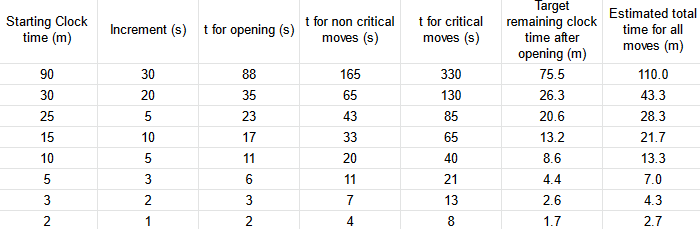
Agree with it or not, at least it gives us a starting point to solve the first problem of how long should we be thinking for. (Don’t even get me started on how we know it’s a critical move or not.) Now we end up facing the second problem. What should we be thinking about? For each of us that’s going to be widely different but suffice to say, we’re all trying to find the best move in the position (Trigger A). In fact this is what most of us train for. Between tactics, calculation puzzles, books, course, and training games we’re all trying to improve our decision making. It’s my opinion that few if any of us are working on Trigger B, the awareness of time during the game. How can we since doing so would require us to pay attention to both the position AND the clock? That’s like trying to listen and participate in two separate conversations at the same time. Alex has a good quote here that maybe helps define the issue:
Poor time management is a symptom of not knowing what to think about. If you move too fast, you aren’t thinking all the thoughts you need to play your best. If you move too slow, you’re thinking thoughts you don’t need to play your best. Practicing time management means practicing what to think about.
When I’m making a move, my thoughts often wander. I go down a chess rabbit hole and emerge in time trouble. Sometimes it’s worth it, usually it’s not.
What is Executive Function
Chess is challenging for many reasons. One of them is that it can give our brains an overwhelming amount of information process. Chess demands so much of our mental capacity that often the brain begins to actively ignore whole sections of the board to reduce the overwhelm. In chess we call that a blunder. Our brain only has a limited amount of processing power and ability to monitor what is happening right now. This ability is known as executive function. Recently two psychiatrists wrote an opinion piece that included a great summary about what executive function is:
“Executive functions encompass core components that include behavioral self-control, attention, mental flexibility (the ability to move from one topic to another), and working memory (capability of keeping information in mind so that it is readily accessible). It also includes complex human thinking, such as the ability to effectively reason, solve problems, and make decisions. Self-control refers to managing one’s emotions — specifically not acting reflexively and impulsively without thinking through the consequences of one’s actions. Finally, executive functions broadly encompass self-awareness, including the capacity to monitor one’s own behavior and detect when errors are being made.”
In short, executive function is not just your self-control but also your self-awareness. It’s your ability to make plans and act on them. It’s your ability to change your plans and actions in response to a dynamic environment. It is the main engine we use when the chess game leaves known territory. Executive function is also one of the last things to develop in a person and one of the first things to diminish as we age.
Physically executive function resides in your pre-frontal cortex, the part of the brain that evolved last. When functioning correctly it acts as a check on your emotions and instincts. Emotions mostly drive behavior thanks to the another part of the brain, the limbic system. This is the place where fear, hope, anger, jealousy, disgust, and trust all reside. When our emotions shift, our behavior shifts unless executive function steps in to guide us. Executive function is your ability to decide where you’re going to place your attention and what you’re going to respond to. It’s the part of your brain that can ignore your opponent’s antics to maintain focus on the board. It’s also a limited resource that gets fatigued as it’s used more throughout the day.
Modern technology with its multiple notifications, messages, sounds, and dopamine loops all sap your ability to exercise self-control. Each time you have to choose to ignore that sound or buzz, the more fatigued you get. Our constant distraction from technology can result in executive dysfunction, where it’s harder to maintain either self control or self awareness. Maybe you’ve experienced this when tired you give in to the sweets you swore you’d not eat. If so perhaps it gives you some sympathy for people with Attention Deficit Hyperactivity Disorder (ADHD) or those who are intellectually gifted. ADHD is literally a disorder of reduced executive function often combined with a brain that processes information quickly. Giftedness acts much the same. Whatever the cause (neurodiversity, sleep deprivation, or constant distraction from technology), executive dysfunction can pose real challenges in a person’s life. When executive function fails, we become dysregulated and overwhelmed. We lose our self control and self-awareness. Picture Bruce Banner turning into the Hulk. Hulk doesn’t play chess, Hulk smash.
Paying Attention to What Has Your Attention
Chess of course is a game of timed decision-making, so there are a couple of best practices we can likely all agree on. Keeping track of the clock seems vital, otherwise we lose on time. Also important would be leaving ourselves enough time to calculate moves accurately in the endgame where a single bad move can lose the game. However, keeping track of time while playing adds to the immense cognitive load that is playing chess. Cognitive load refers to the theory that we can only pay attention to so much (famously 7 +/- 2 things at once). We can lose track of a bishop in the corner very easily when there’s tension in the center. We can also lose our focus when we have to attempt to ignore sounds in the playing hall or our opponent’s antics. Whatever we have to pay attention to comes at a cost, both figurative and literal. Without training, our attention (aka executive function) will eventually get weaker and we revert back to the soft focus of our default mode network. This is when our mind starts to wander and thoughts become intrusive.
A mindfulness practice is one thing that really helps here. In most mindfulness practices, the goal is to place your attention on one thing and when you notice you’ve become distracted to simply bring it back. This is the heart of mindfulness, the practice of just noticing what has your attention. Once aware, you can make choices. This was the entire point of Dr. Kabat-Zinn’s talk, that we have choice. Stress, a modern problem, is in someways a lack of awareness of the freedom of action we actually possess. There’s an old quote about this:
“Between stimulus and response there is space.
In that space is our power to choose our response.
In our response lies our growth and our freedom.”
When I play chess and my opponent makes a provocative move, my emotions get stirred. I get reactive and my first instinct is to respond with the best looking move. I’ve made more blunders this way than I care to admit. I have an old bad habit of “see move, make move” that comes out under stress. However, stress is simply something I’m agreeing to and not actually the case. It seems ironic to me that I can calmly deal with dying people routinely but should my opponent push an errant pawn towards my king I get stressed out. So many emotions come out, especially fear. I feel a need to get control of the situation on the board.
This is the place where my executive function should kick in, and many times it does. The problem is when it doesn’t. Executive function is a limited resource that gets taxed by keeping emotions in check and resisting temptations. However, we can build it up through playing games with intention to play slowly. There are cues we can use to form habit loops. Writing down your opponent’s move can serve as that cue to slow down. Writing down your move and your time helps bring time into your awareness. Lastly, we can practice mindfulness daily like our lives depended on it. One fantastic resource made with the chess player in mind is Mindfulness for the Tournament Player by Dr. Benjamin Portheaulth.
Whatever you choose to do, your executive function is often a rate limiting step in chess improvement. It is our primary ability to keep attention on what has our attention. Without it, we simply respond to external stimuli and fail to exercise the only control we have in life.
Thanks for reading! Hope you enjoyed it. Would love to hear your experience!
TL,DR
Let’s sum up what we’ve talked about today. Executive function is our ability to be self aware and direct our attention where we want to put it. Executive function also is one of the last parts of our brain to develop as we age. It’s harder for kids (and elderly) to resist temptation or impulses because emotions predominate when executive function is weak. Executive function is the skill we need to allow ourselves to pause and consider the moves we want to make instead of just moving. Many people struggle with executive function because of modern technology or conditions like ADHD. To play our best chess we need to be able to not only calculate but also monitor our time. Finding moves too quickly can be just as bad as taking too long for a single decision. We also need to keep our cool under stress while playing. Our best decisions are made when our emotions are regulated. This is where executive function shines, keeping our focus where we want it and providing us with awareness of our own mind. However, in my opinion, is what makes chess so difficult. We are asked to do the hardest thing ever, to remain aware of our thinking while fully engaged in calculation. That’s a challenge for everyone. By practicing mindfulness (placing and keeping our attention on something), we can strengthen our executive function and find the space between stimulus and response.
Another great article Doc. As an older adult improver I can not tell you the number of times I have blundered in the latter part of the middle or end game because my focus wondered to a specific area of the board. The tip on Mindfulness Practice by Dr Kabat-Zinn is something I am going to look into. Thanks again for taking the time and energy to share your thoughts and ideas, they are always helpful.
I really like the executive functioning frame you pointed out - chess is really just one decision after another, and it's hard to find the right balance between speed and caution, aggression and, well, caution. When I'm moving too fast I generally find that I can slow myself down by trying to find something interesting about the position that engages my attention, a puzzle or problem to solve because chess is never simple or obvious. When I'm moving too slow I generally have to ask myself "Do I really want to keep messing around and lose on time to this person?" and since the answer is always no I then set a strict goal for how much time I'll have 10 to 15 moves down the line. It seems to work decently without adding too much cognitive load.